









Version 1.3, updated August 2023
A. Scope
This program provides DarkSky International certification for outdoor sports lighting (OSL) facilities, specifically the lighting of outdoor playing field surfaces illuminated by sports lighting equipment designed for that purpose. DarkSky certifications and awards are reserved for outdoor lighting that has been proven to significantly reduce light pollution relative to non-certified facilities of similar functionality.
B. Certifications
This certification is for lighting installations for the field(s) of play and includes analysis and measurements for the field(s) and immediate surround only. Multiple contiguous fields of play that share lighting equipment are considered one application for offsite and sky glow impacts, although illuminance levels must be differentiated for each field if the design criteria differ. Submittals for DarkSky OSL certification must demonstrate conformance with the DarkSky Lighting Criteria in Section 2. There are two phases of the certification process:
A. Environmentally Sensitive Zones
DarkSky International does not certify sports lighting facilities located in areas especially sensitive to lighting, such as CIE Environmental Zones E0 and El, or IDA/IES Lighting Zone LZ0.
A. Local Codes
The project must be in compliance with all applicable local codes and standards (e.g., state, province, county, or municipal lighting ordinances, building and electrical codes, energy codes, and product labeling such as by Underwriters Laboratories or equivalent).
B. Lighting Standards
The basis for on-field illuminance values shall be the latest version of ANSI/IES RP-6, Recommended Practice: Lighting Sports and Recreational Areas, unless the owner, location and/or authority having jurisdiction mandates compliance with a different lighting standard. If a different standard is required, the applicant shall submit the name of the standard in the application along with the prescribed design criteria values for the application(s).
A. aerial sports
For the purpose of this program, aerial sports are those in which the height of a ball in play would, in the normal course of playing the sport, exceed the height of the sports lighting poles. This category is limited to baseball, softball, cricket, and American football (fly balls and kick-offs are examples of plays with high-flying balls). In these cases, some uplight is required for ball visibility (see Section 2.2).
B. class of play
This is determined by standards development organizations and, in combination with the specified sport being played, is a determinant for light level recommendations. Applicants must provide the class of play for each playing field included in the application to determine the appropriate illuminance level.
C. control zone
A group of light fixtures that are controlled together, i.e., switched and/or dimmed together.
D. field of play, playing field
For the purposes of this document: the field, court, pool, or other area where the relevant sport is played.
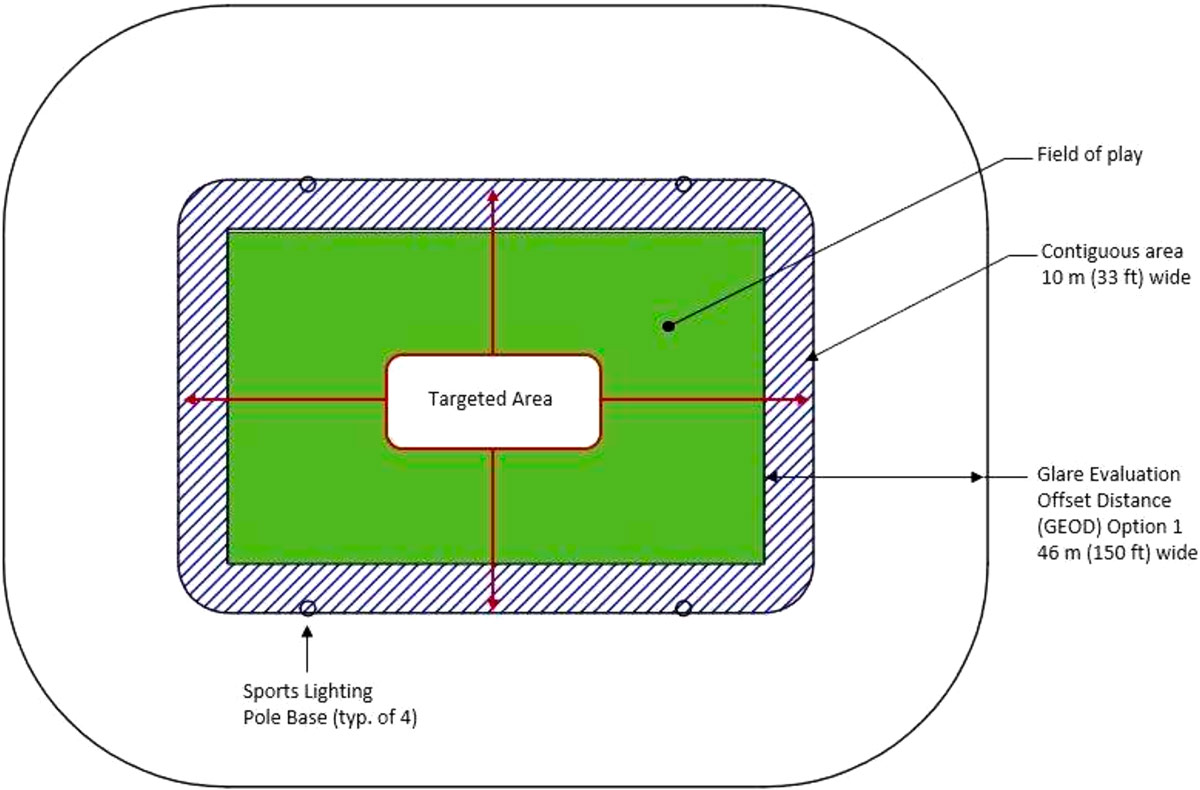
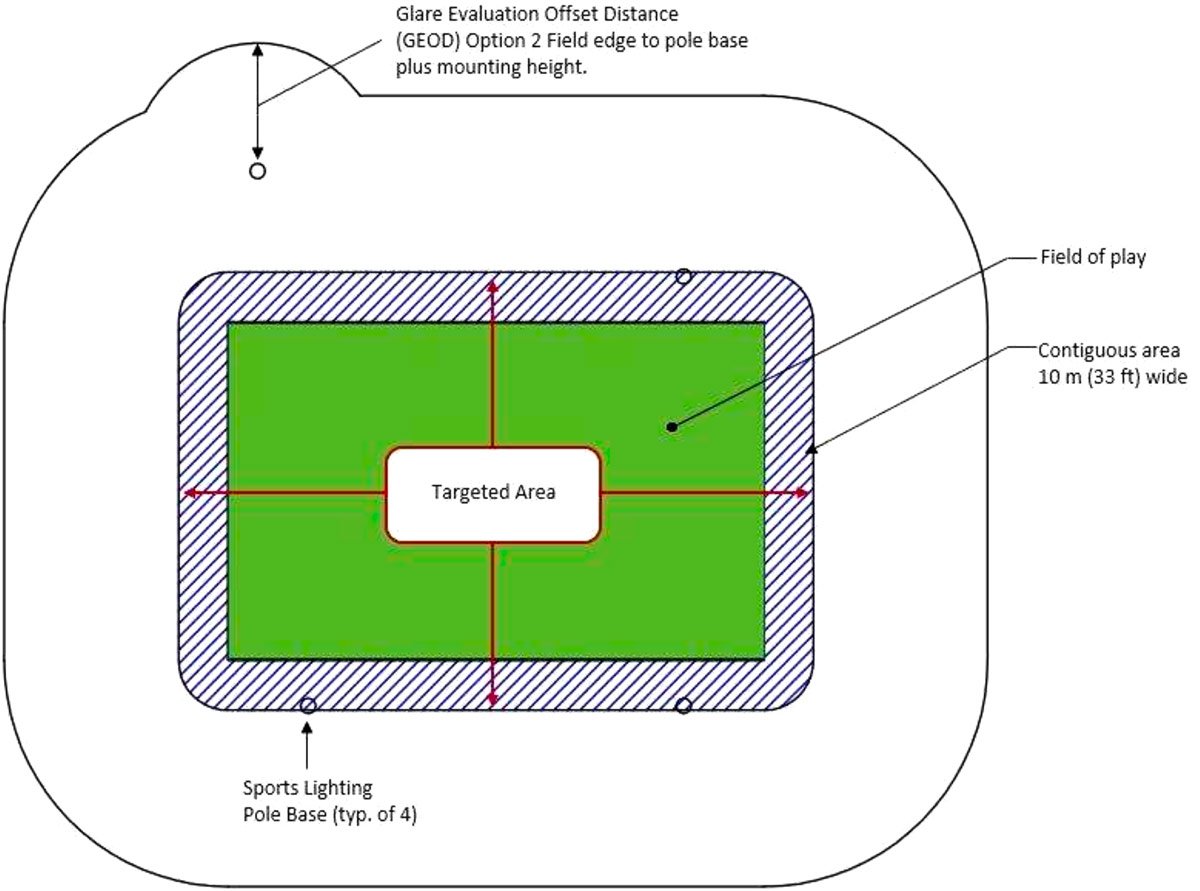
E. glare evaluation offset distance (GEOD)
The distance between the edge of the playing field and the point at which the glare criteria will be evaluated through computer calculations in Phase 1 and field measurements in Phase 2. This GEOD is the perpendicular distance extending outward from the edge of the playing field equal to whichever of these values is greater:
If access to the GEOD is not possible due to obstructions such as buildings or landscaping, the field measurements shall be evaluated from representative locations as practicable.
F. targeted area
The region defined as the playing field(s) plus the contiguous area extending 10 meters (33 feet) beyond the playing field perimeter. (See Figures 1-1 and 1-2.)
A. Sports Field Lighting
A. Sports Field Lighting
A. The maximum allowable luminous intensity from any luminaire lighting a sports field is 1,000 candelas as measured for each field of play at the glare evaluation offset distance (GEOD; see Section 1.4.E). Calculations and measurements at this GEOD perimeter shall be at 1.5 meters (5 feet) above finished grade, and the calculation and measurement points shall be spaced 3 meters (10 feet) apart around the entire perimeter.
B. The luminous intensity calculation shall be verified during Phase 1 through the computer calculation report and during Phase 2 through field measurements.
A. Sports Field Lighting
A. Automatic Controls
Automatic control systems with remote control capability via smartphone apps or direct remote communication to the company or facility responsible for handling the lighting controls are required to enforce shut-off at the locally established curfew time, but not later than 11:00 p.m. (2300 hours).
B. Manual Controls
The automatic control system may include onsite manual and/or remote control capability to allow for the lights to be turned on or off at will (between dusk and curfew) to ensure that only active sports fields are lighted. Manual controls shall be accessible to authorized personnel only.
C. Dimming Controls
The control system shall include automatic and manual dimming capability to implement uniform and variable illumination levels, to adapt for different task lighting needs on the field, such as for class of play, competition athletics, band practice, striping, mowing, and sports practice. Dimming for the different uses shall be programmed as presets for each of the uses. Dimming shall be possible across the range of 25% to 100% of full illumination.
D. Separate Control Zones
Lighting control zones (see Section 1.4.C) are required to separate fields of play into different zones and to separate the down lighting and uplighting for each field into different zones. The lighting for other areas such as concessions stands and parking lots shall be zoned independently of the playing field lighting; however, they must still follow all other controls criteria contained in Section 2.5.
E. Control Policy Documentation
A formal lighting policy must be included in the Phase 1 application. The policy shall include the planned types of activities for each playing field, the illuminance levels for each of those activities, and the curfew time for each of those activities. All listed conditions in the schedule must be demonstrated during the Phase 2 inspection.
A. Sports Field Lighting
A. Applicants must apply for the program and upload lighting calculations and supplemental information through the online application.
B. Submissions must include the following:
A. Design Evaluation
DarkSky International will evaluate materials sent by applicants for conformance with the DarkSky Lighting Criteria (see Section 2) and provide applicants with feedback.
B. Conformance
If the project design conforms with the DarkSky Lighting Criteria, DarkSky International will inform the submitter and provide a letter of congratulations to the applicant. The project will also then be filed at DarkSky International as an OSL-Compliant Design and be put in the queue for the Phase 2 Installation Certification process.
C. Nonconformance
If the project does not conform with the DarkSky OSL Criteria, DarkSky International will inform the applicant. They will have the opportunity to change the design to meet the lighting criteria and resubmit their design (see paragraph 3.1.B.2 Submission Fees).
A. Scheduling the Inspection
Upon completion of the project, DarkSky International must be contacted to coordinate a date and time for the field evaluation. The Owner’s representative must be present for the inspection to provide full access to the site, and time must be allowed for all measurements required to demonstrate conformance with the DarkSky OSL Criteria. The system must be fully operational, with all controls fully working, to test each control zone and light level at night for conformance with the control schedule approved in Phase 1.
B. Inspection Fees
C. DarkSky International will provide the following deliverables:
A. DarkSky installation certifications are given only after the field inspection has demonstrated full compliance with the lighting criteria described in this document (see Section 2).
B. DarkSky certifications allow the owner of the facility to place a DarkSky International-provided placard on their facility notifying the public of the DarkSky Compliant certification.
C. DarkSky International promotes all certified facilities on the DarkSky.org website, recognizing the name of the field and the owner or municipality that operates the facility.
The following background is provided for the reader to better understand the rationale within this document.
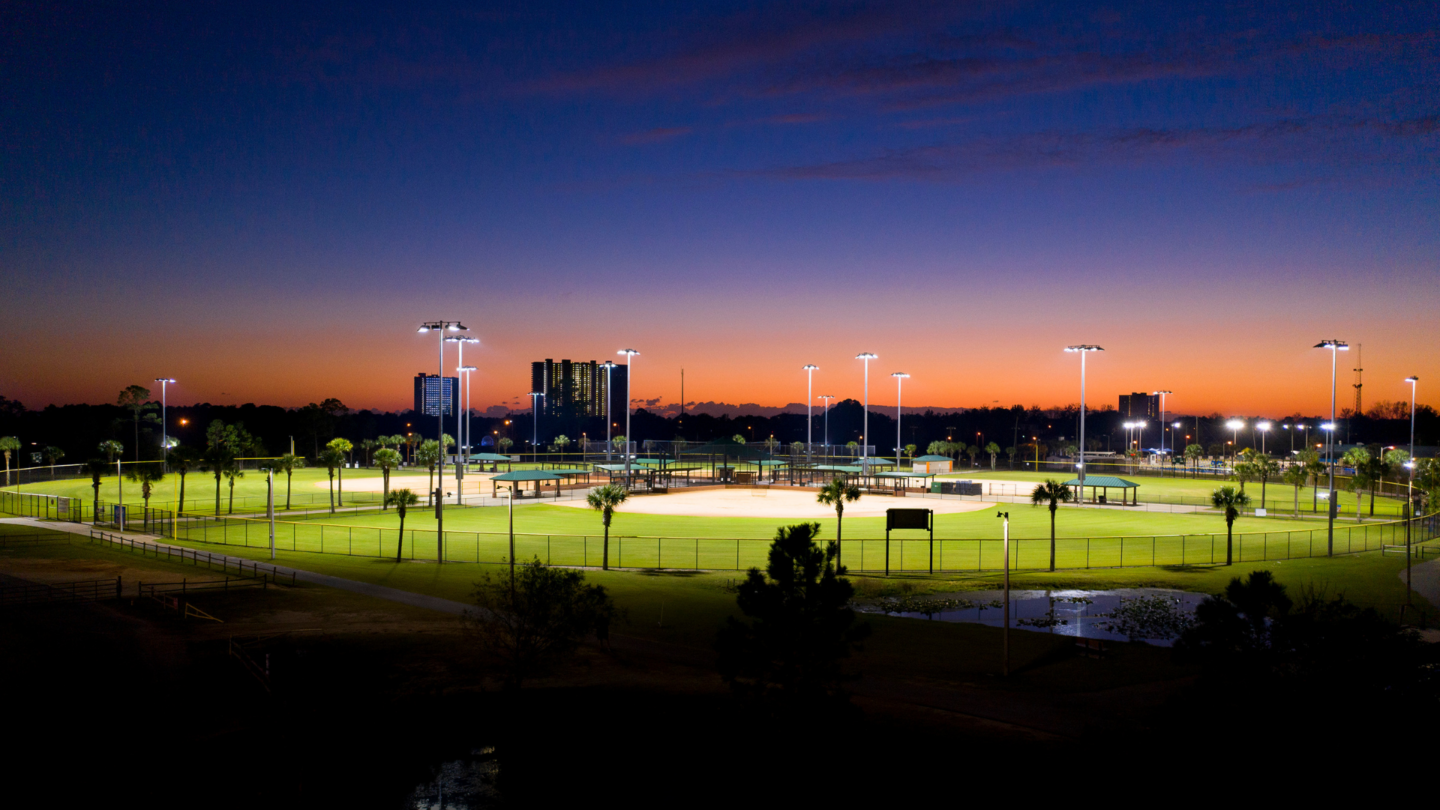
Sports lighting applications have a high potential for light pollution due to the brighter than normal lighting equipment required for playing sports. Sports lighting luminaires are often cited as nuisance lighting, as they can be excessively glaring and can be seen from great distances away from the playing field.
Changing sports lighting from metal halide lamps to LED lighting systems provides an opportunity to improve sports lighting and reduce light pollution, because the beam of light and the light levels provided by LEDs can be more precisely controlled. By using improved optical controls to limit the light to the area of play, proper shielding to minimize offsite glare, dimming controls, and timing controls, the effectiveness of lighting a sports field is increased while energy use and light pollution are decreased.
This theory was put to test at a proposed sporting complex in Sahuarita, Arizona, United States, at a site that was near the Whipple Observatory on Mt. Hopkins in Southern Arizona. In this case, the lighting design team met with the observatory personnel and city leaders to discuss whether it might be possible to light a sporting complex without compromising the needs of astronomers and others for dark, unpolluted skies, and without providing light levels or glare that would annoy neighbors. The goals of the project were focused on the need for minimizing light pollution, glare, and light trespass while also allowing for recreational activities during nighttime hours. A solution was put in place that satisfied everyone. The results are shown below. After the installation was completed, a group of DarkSky advocates including members of the DarkSky Technical Committee gathered at the site and took measurements that could then be used to establish criteria for future installations. The DarkSky Approved Outdoor Sports Lighting Program criteria were therefore established from a proven installation that meets DarkSky objectives, and has proven to meet astronomical observers’ needs as well. This project proved that lighted sporting venues and dark sky initiatives can coexist.
To learn more, contact the DarkSky Lighting Program Manager.
Outdoor-Sports-Lighting-Guidelines-v1.3-08-28-2023.pdf (PDF)
If you’re ready to apply, make sure you’ve reviewed the guidelines above, then fill out the form.
Phase 1 payment is due upon form submission.