









If you have found yourself squinting more often at the bright, blue glare of oncoming traffic in recent years, you are not imagining it. And you are not alone.
Car headlights have been getting brighter, a shift many drivers experience firsthand and one that has become a growing public concern. The American Automobile Association (AAA) reports a steady stream of complaints about the intensity and glare of modern headlights, particularly newer LED and HID systems. In the United States, the issue escalated to the national stage in 2025 when Representative Marie Gluesenkamp Perez called for federal action to address increasingly blinding headlights. In the United Kingdom, similar concerns prompted the government to launch a formal review in 2024, following widespread complaints from drivers about glare.
So far, the conversation has largely focused on driver discomfort and road safety. But there is another side to this story—one that reaches beyond the road—that has received far less attention.
DarkSky’s mission is to restore the nighttime environment and protect communities from the harmful effects of artificial light at night, and vehicle headlights cannot be ignored. As traffic volumes rise and lighting technology evolves, addressing this growing environmental threat through thoughtful lighting and design solutions is essential to protecting the night for both people and the planet.
The Five Principles for Responsible Outdoor Lighting offer a strong starting point for these conversations. While they were not developed specifically for vehicle headlights, the principles provide a clear framework for rethinking headlight design in ways that support safety while reducing unnecessary light and protecting the nighttime environment. In response, DarkSky’s board has released five recommendations grounded in these principles to help guide future initiatives and solutions on this issue.
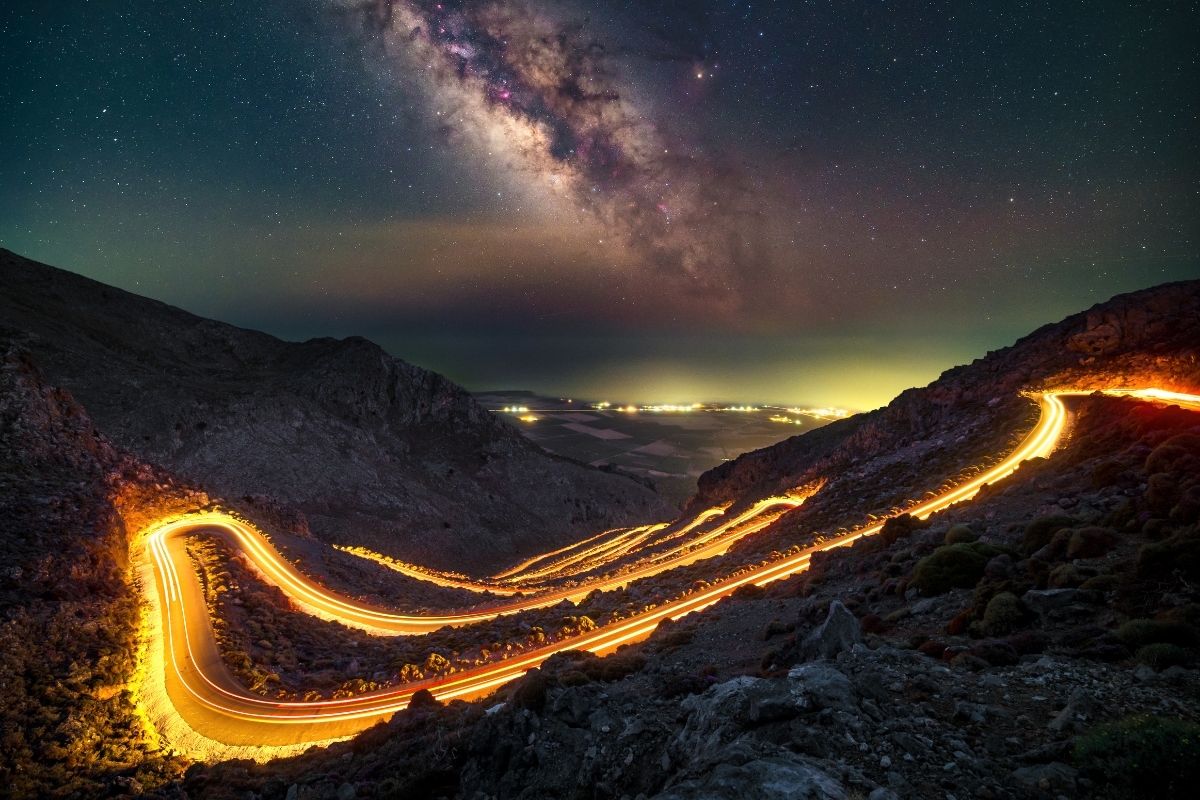
Each night, millions of vehicles cast powerful beams of artificial light that spill beyond the road, cutting through forests, grasslands, wetlands, and deserts. Unlike streetlights or other infrastructure lighting, headlights are mobile, intense, and projected horizontally, allowing light to penetrate deep into habitats that would otherwise remain dark.
This moving, horizontal light reaches places untouched by permanent lighting, including rural roads, protected landscapes, and undeveloped land. As a result, vehicle headlights introduce artificial light into vast areas that are otherwise considered dark or pristine.
Artificial light at night is a well-documented environmental pressure. It disrupts wildlife behavior, alters ecosystems, and interferes with biological rhythms that have evolved over millions of years. Yet most research, policy, and mitigation efforts have focused on fixed sources of light, such as streetlights, buildings, and sports facilities.
Vehicle headlights are different, and they have largely been overlooked.
For wildlife that depends on natural darkness to navigate, feed, and reproduce, these passing flashes of light represent a growing and largely unregulated form of light pollution.
Taken together, these characteristics make vehicle headlights one of the most widespread and least understood sources of artificial light at night.
While brighter beams are exacerbating the problem, several characteristics of modern headlights make them particularly detrimental to the nighttime environment.
Modern headlights are designed to illuminate far down the road, but that visibility comes at a cost. Even at distances of 50 meters, headlight beams can expose roadsides to light levels far brighter than natural nighttime conditions. For comparison, a full moon provides only about 0.1 to 0.3 lux, while headlight emissions can reach around 25 lux. For wildlife adapted to darkness, even brief exposure can disrupt feeding, movement, and natural behaviors.
Unlike most outdoor lighting, which is intended to shine downward, headlights project light horizontally. This allows beams to bypass traditional shielding and spill directly into nearby forests, fields, wetlands, and waterways. As a result, light from passing vehicles can penetrate deep into habitats that would otherwise remain dark, extending the reach of artificial light far beyond the roadway.
Vehicle headlights introduce artificial light at night into vast landscapes that lack permanent street lighting. In Great Britain, an estimated 2,380 square kilometers of land alongside roads are exposed to headlight emissions, more than twice the area of the region’s natural and semi-natural grasslands. Even in remote areas, nearly all of this habitat is illuminated at some point by passing vehicles.
Many modern LED and xenon headlights emit blue-rich, cool-white light. Blue light is particularly disruptive at night, suppressing the production of melatonin and disrupting circadian rhythms in many species. In ecological terms, not all light is equal, and blue-rich light causes greater harm after dark.
Headlights don’t stay on in one place. Each passing vehicle creates a sudden, unpredictable burst of intense light, followed by darkness again. For nocturnal insects, especially, this is a serious problem. Many species cannot quickly adjust their vision after exposure, leaving them disoriented, exhausted, or vulnerable to predators long after the car has passed.
The ecological pressure from vehicle headlights is rising fast. As global traffic increases and road networks expand, artificial light from passing vehicles is reaching farther into the night, touching places that were once reliably dark.
Worldwide traffic is expected to double by 2050, alongside the construction of roughly 25 million kilometers of new paved roads. Each new stretch of pavement brings headlights into landscapes that may never have experienced artificial light before, including some of the world’s most remote and biodiversity-rich regions.
What makes this threat especially difficult to grasp is how much of it remains unseen. Satellite images commonly used to map light pollution are designed to detect steady, upward-facing light from cities and streetlights. They largely miss the temporary, horizontal beams of vehicle headlights, meaning the true extent of this growing pressure on the nighttime environment is almost certainly underestimated.
The same headlight characteristics that cause ecological harm, particularly high intensity and blue-rich light, are also linked to issues for our own well-being. Excessive brightness can increase glare, reduce contrast, and create visual discomfort for oncoming drivers, especially older drivers.
This overlap creates an important opportunity. Improving how headlights are designed and controlled does not have to mean choosing between environmental protection and public safety. Smarter lighting that reduces unnecessary brightness and glare can benefit wildlife, improve driver comfort, and support safer nighttime travel.
Vehicle headlights represent a major, scientifically documented, and rapidly growing source of ecological light pollution that has been largely overlooked in environmental policy. DarkSky is working to help close this gap by continuing to focus attention on this growing concern.
To guide future initiatives and solutions on this issue, DarkSky’s board has developed five recommendations grounded in the Five Principles for Responsible Outdoor Lighting, specifically aimed at vehicle headlights.
As this work continues, we encourage our community to stay connected through DarkSky communications. In the months ahead, we will be building momentum around this issue to raise awareness within the lighting design community and the automotive industry. Be on the lookout for upcoming opportunities to engage and help advance solutions that protect the night.
Do car headlights contribute to light pollution?
Yes. While often overlooked, vehicle headlights are a widespread source of artificial light at night. Their intensity, horizontal projection, and mobility allow light to reach far beyond roads into natural habitats.
Why are modern headlights brighter than older ones?
Advances in LED and HID technology allow headlights to produce more intense, blue-rich light, often without the same controls found in older systems.
Why is blue-rich light harmful at night?
Blue light is uniquely disruptive: It suppresses melatonin and disrupts circadian rhythms in many species of wildlife and humans more strongly than other wavelengths. Because blue light also scatters more easily in the atmosphere, it is a primary driver of sky glow, brightening the night sky far more than warmer tones.
Can headlights be designed to reduce environmental impact?
Yes. Adaptive lighting, improved beam control, and limits on unnecessary brightness can improve safety while reducing light pollution.


As long as Earth has spun on its axis in orbit around the sun, the planet has known night. …