







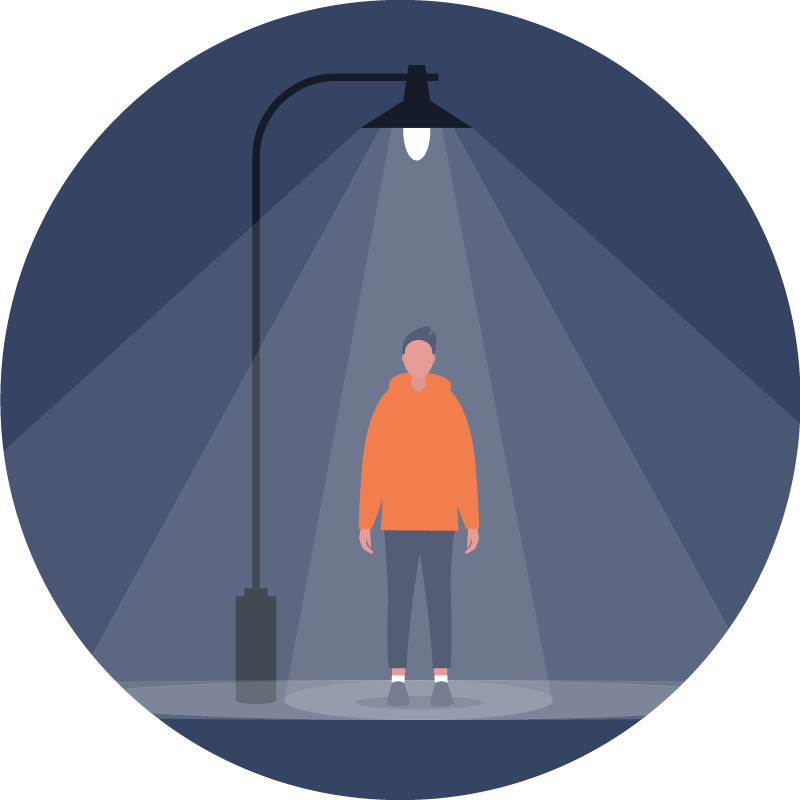

“Lighting zones“ (LZ) reflect the base (or ambient) light levels desired by a community. The use of lighting zones was originally developed by the International Commission on Illumination (CIE) and appeared first in the U.S. in IES RP-33-99, Recommended Practice for Exterior Environmental Lighting. To learn more, read about our Model Lighting Ordinance.
At this time, DarkSky recommends the use of five outdoor lighting zones:
Lighting zones reflect the base (or ambient) light levels desired by a community and are commonly implemented as an overlay to the established zoning, especially in communities with a variety of zone districts.
It is recommended that lower lighting zone(s) be given preference when establishing zoning criteria. The selection of a lighting zone or zones should be based not on existing conditions but on the type of lighting environments the jurisdiction seeks to achieve. For instance, new development on previously rural or undeveloped land may be zoned as LZ1.
Lighting zones are best implemented as an overlay to the established zoning, especially in communities with a variety of zone districts within a defined area or along an arterial street. Where zone districts are cohesive, assigning lighting zones to established land use zoning may be possible. It is recommended that the lighting zone include churches, schools, parks, and other uses embedded within residential communities.
LZ0: No ambient lighting
Recommended uses or areas:
Lighting zone 0 should be applied to areas in which permanent lighting is not expected and when used, is limited in the amount of light provided and the period of operation. LZ0 typically includes undeveloped areas of open space, wilderness parks and preserves, areas near astronomical observatories, or any other area where the protection of a dark environment is critical. Special review should be required for any permanent lighting in this zone. Some rural communities may choose to adopt LZ0 for residential areas.
Zoning considerations:
LZ1: Low ambient lighting
Recommended uses or areas:
Lighting zone 1 pertains to areas that desire low ambient lighting levels. These typically include areas with single- and two-family residential domiciles; rural town centers; business parks; and other commercial, industrial, or storage areas, typically with limited nighttime activity. It may also include the developed areas in parks and other natural settings.
Zoning considerations:
LZ2: Moderate ambient lighting
Recommended uses or areas:
Lighting zone 2 pertains to areas with moderate ambient lighting levels. These typically include multifamily residential uses; institutional residential uses; schools, churches, hospitals, hotels, and motels; commercial and/or businesses areas with evening activities that are embedded in predominately residential areas; neighborhoods serving recreational and playing fields; and/or mixed-use development with a predominance of residential uses. It can be used to accommodate a district of outdoor sales or industry in an area otherwise zoned LZ1.
Zoning considerations:
LZ3: Moderately high ambient lighting
Recommended uses or areas:
Lighting zone 3 pertains to areas with moderately high lighting levels. These typically include commercial corridors; high-intensity suburban commercial areas; town centers; mixed-use areas; industrial areas and shipping and rail yards with high nighttime activity; high-use recreational and playing fields; and regional shopping malls, car dealerships, gas stations, and other nighttime-active exterior retail areas.
Zoning considerations:
LZ4: High ambient lighting:
Recommended uses or areas:
Lighting zone 4 pertains to areas with very high ambient lighting levels. LZ4 should only be used for special cases and is inappropriate for most cities. LZ4 may be used for extremely unusual installations, such as high-density entertainment districts, and sometimes for heavy industrial uses.
Zoning considerations:
Download the MLO:
Model Lighting Ordinance (MLO) PDF (2011) (PDF)
As discussed above, Lighting zones are based on CIE environmental zones. These were reaffirmed in a recent Technical Report CIE 150:2017, Guide on the Limitation of the Effects of Obtrusive Light from Outdoor Lighting Installations, 2nd edition.
This Technical Report establishes the following environmental zones, based upon ambient brightness, as a framework for limiting obtrusive light.
E0: Intrinsically Dark. Examples include UNESCO Starlight Reserves, International Dark Sky Parks, major optical observatories
E1: Dark. Examples include relatively uninhabited rural areas.
E2: Low district brightness. Examples include sparsely inhabited rural areas.
E3: Medium district brightness. Examples include well-inhabited rural and urban settlements.
E4: High district brightness. Examples include town and city centers and other commercial areas.
Note: Regardless of the level of urban development, the recommendations for E0 or E1 should be followed for all locations within 100 km of a major optical astronomy observatory. Regardless of the level of urban development, the recommendations for E2 (or better) should be followed for locations within 30 km of an operating urban optical astronomy observatory, and for locations between 100 km and 300 km from a major optical astronomy observatory.