










Version 1.0, updated August 2025
The Port Marine Terminal Lighting (PMTL) Program is established by DarkSky International (DarkSky) to promote high-quality lighting for shoreline port terminals that minimizes light pollution, including sky glow, light trespass, obtrusive light (visible light sources and glare), and potentially harmful impacts to people, flora and fauna.
The program gives recognition to those facilities that, in addition to providing lighting for safety and their intended function, prioritize environmental protection and nuisance avoidance. For a port marine terminal lighting installation to be DarkSky Approved, it must demonstrate that it meets the criteria in this document, which are based on the objectives of the DarkSky/Illuminating Engineering Society (IES) Five Principles for Responsible Outdoor Lighting. Those Principles are:
This document explains the requirements for a port marine terminal to become DarkSky Approved, including both technical performance specifications and administrative requirements.
For questions on the program, contact the Lighting Program Manager
TABLE OF CONTENTS
3.0 PHASE 1 – DARKSKY DESIGN COMPLIANCE
4.0 PHASE 2 – DARKSKY INSTALLATION COMPLIANCE
A. Scope
This document provides the criteria for meeting the DarkSky Approved Port Marine Terminal Lighting (PMTL) Program. This program provides DarkSky International (DarkSky) recognition for port marine terminal Work Zones where marine vessels load and discharge cargo and passengers, and include related work areas such as upland storage and/or transportation areas. Program compliance is evaluated on the basis of lighting calculations and controls within individual Work Zones and offsite impacts are based on the outer perimeter of multiple contiguous Work Zones that share lighting equipment within the same project. DarkSky Approved recognition is reserved for outdoor lighting that has been proven to significantly reduce light pollution relative to other facilities of similar functionality.
B. Mandatory and preferred certifications
All requirements listed in these criteria are mandatory to achieve DarkSky Approved recognition. A Preferred status is given for facilities that meet the Preferred requirements listed in Section 2.5, Spectrum. Recognition is given in the form of a letter for Phase 1 and a full certificate for Phase 2 as outlined below.
C. Design and installation recognitions
The recognition offered in this program is for lighting installations for the port Marine Terminal Work Zones only. Submittals for DarkSky Approved recognition must demonstrate conformance with the DarkSky Lighting Criteria in Section 2. There are two phases of approval:
A. Local codes
The project must be in compliance with all applicable local codes and standards (e.g., federal, state, province, commonwealth, county, or municipal lighting ordinances, building, safety and electrical codes, energy codes, and product labeling such as by Underwriters Laboratories or equivalent).
B. Lighting standards
The basis for on-site illuminance values shall be the latest version of ANSI/IES RP-40, Recommended Practice: Lighting Port Terminals, unless the owner, location and/or authority having jurisdiction mandates compliance with a different lighting standard. If a different standard is required, the applicant shall submit the name of the standard and the design criteria of the standard in the application.
A. Lighting trespass
The vertical illuminance calculated or measured 1.5 m above finish grade at the specified boundary lines, aimed perpendicular to the boundary line and directed into the port marine terminal property.
B. Marine terminal
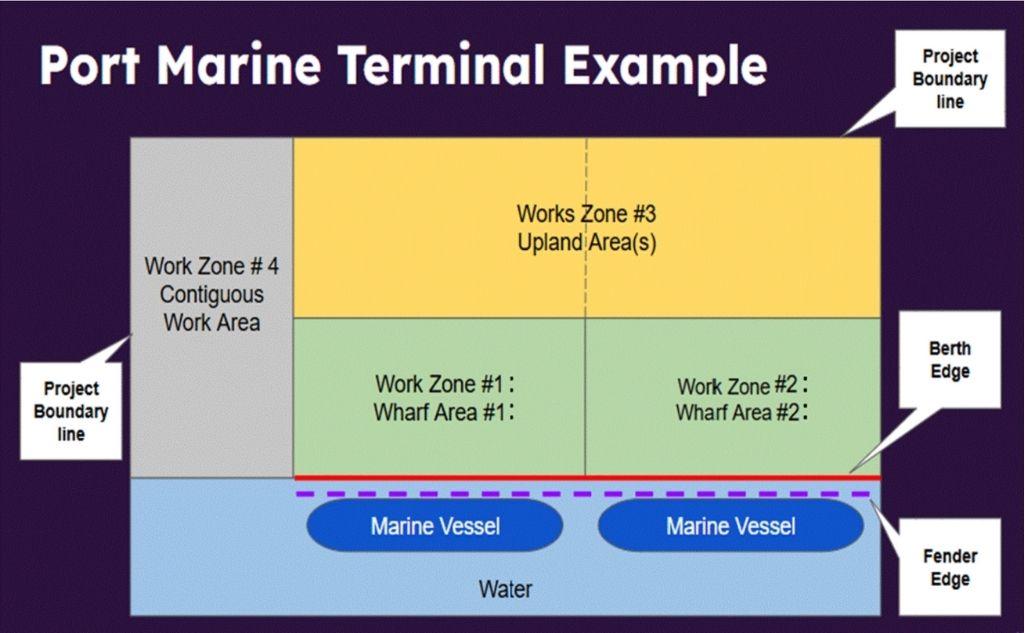
Collection of berthing locations and adjacent upland areas and/or waterfront Work Zones associated with the movement and/or storage of cargo, materials or passengers from vessel to shore or shore to vessel. Each Wharf Area constitutes a separate area for lighting purposes, and must have its own separate controls for tuning the lighting to meet the operational setting/non-operational settings for both the Wharf Area and the Upland Area.
C. Operational setting/non-operational hours/setting
The Operational Setting is the light level/CCT combination allowed during operational working hours, i.e. when the vessel is being unloaded or loaded, or when other operational work is being performed in the Upland Area. The Non-Operational Setting is the light level/CCT combination allowed at all other times, including when the vessel is moored, but no work is being performed in the Work Zone.
D. Tuning
Dimming and color changing capability of a luminaire to achieve the light settings required.
E. Upland area
Land area on the upland side of the Marine Terminal not associated with the act of loading or unloading of waterborne shipments or passengers and where supplemental work is performed, including but not limited to container storage, bulk storage or other work that is otherwise connected to the operation of the marine terminal. Upland areas are not necessarily aligned with Wharf Areas and may serve multiple Wharf Areas.
F. Wharf area
The area between the limits of the upland area(s) and waterside operations. The extent of the waterfront dimension must be defined for each Wharf Area.
G. Work zone
Area of the marine terminal where work is performed. For the purpose of this program, Wharf Areas and the Upland Areas shall be different Work Zones, and Work Zones may have different boundaries for the Operational Settings and Non-Operational Settings, i.e. when the boundary of the Work Zone for the Wharf Area extend to the fender edge during Operational Hours, but end at the berth edge during Non-Operational Hours. Waterfront Work Zones that are not berthing locations, but contiguous with Wharf Areas are considered separate Works Zones.
A. Criterion
No luminaire, as positioned and aimed in its final installed position, is allowed to emit light above 80° from nadir. Note: Having a luminous intensity of zero candelas emitted at or above 80° from nadir when a luminaire is aimed directly downward, as shown in a photometric report, is not sufficient for compliance if the luminaire is tilted (i.e., aimed above nadir) in its installed position.
B. Calculation
Calculations shall include the sum of the total lumens generated by all of the luminaires aimed at the Work Zone, as emitted in their final aimed position, for 1) lumens emitted above 80° from nadir, and 2) lumens emitted below 80° from nadir. Note: The total lumens emitted above 80° from nadir in this calculation must be zero to comply with the criteria.
A. Work zone targeting
B. Light trespass
A. Criterion
If the basis of design criteria is average illuminance over the area of the port terminal Work Zones, then the average illuminance on port terminal Work Zones shall be no more than 25% above the average target illuminance levels defined by the relevant standard (see Section 1.2.B). If the basis of design criteria is a minimum value at the berth edge, then the average to minimum ratio over the area of the port terminal Work Zone shall be no greater than 5:1.
B. Illuminance Calculations
The design documents must specify the boundaries of the Work Zones for each Marine Terminal for both the Operational and Non-Operational Settings. For instance, if the Marine Terminal application includes both an Upland Area and a Wharf Area, then the Work Zone for each of these areas needs to be defined for the Operational Setting and the Non-operational Setting (if different). The illuminance calculations shall be performed on DarkSky International-approved software and show compliance via a plan view and illuminance grid, with the calculated average, minimum, and maximum illuminances at ground level for each Work Zone under each of the settings. The point spacing in the illuminance grid shall be as specified in the standard, or no more than 3 m (10 ft) apart if the spacing is not specified in the standard. In addition to the illumination grid, the documentation must include the illuminance along the berth edge at the same grid spacing. The total light loss factor (LLF) shall be no lower than 0.8.
A. Automatic controls
Automatic control systems shall provide astronomical on/sunrise off operation with the ‘on’ setting programmed for the Non-Operational Setting. Manual override controls to increase the lighting to the operational setting are allowed.
B. Tuning controls
The control system shall include tuning capability to implement uniform illumination levels for the Operational and Non-Operational Settings.
C. Separate control zones
Each Work Zone shall be a separate lighting control zone. Upland Areas that are contiguous and operate together may be controlled together if they are included as part of the same DarkSky application and documentation is provided from the Owner that describes why they must be controlled together.
D. Control policy documentation
A control schedule tied to a lighting zone plan must be included in the Phase 1 application that shows the control zones and lists the controls method and the Operating and Non-Operating Settings for each control zone. All listed conditions in the schedule must be demonstrated during the Phase 2 inspection.
A. Mandatory maximum CCT
The maximum allowable correlated color temperature (CCT) of light sources is 4000 K.
B. Preferred maximum CCT
DarkSky Preferred status for Port Marine Terminal projects can be achieved by reducing the CCT to 3000K or lower for the Operating Setting and/or Non-Operational Settings. For instance, if a Port Marine Terminal has 3000K throughout the project in both Operational and Non-Operational Settings, it would achieve a Preferred status; or if the project uses spectral tuning to reduce the CCT to 3000K or below during Non-Operational Hours, it would receive Preferred status. DarkSky advocates for an even lower CCT for the Non-Operational Setting.
A. Applicants must apply for the program and upload lighting calculations and supplemental information through the online submittal form here.
B. Submissions must include the following:
A. Design evaluation
DarkSky International will evaluate materials sent by applicants for conformance with the DarkSky Lighting Criteria (see Section 2) and provide applicants with feedback.
B. Conformance
If the project design conforms with the DarkSky Lighting Criteria, DarkSky International will inform the submitter and provide a letter of congratulations to the applicant. The project will also then be filed at DarkSky International as a PMTL-Compliant Design and be put in the queue for the Phase 2 Installation Certification process.
C. Nonconformance
If the project does not conform with the DarkSky PMTL Criteria, DarkSky International will inform the applicant. Applicants will have the opportunity to change the design to meet the lighting criteria and resubmit their design. (See paragraph 3.1.B.2 Submission Fees.)
A. Scheduling the inspection
Upon completion of the project, DarkSky International must be contacted to coordinate a date and time for site evaluation. The Owner’s representative must be present for the inspection to provide full access to the site, and time must be allowed for all measurements required to demonstrate conformance with the DarkSky PMTL Criteria. The system must be fully operational, with all controls fully working, to test each control zone and light level at night for conformance with the control schedule approved in Phase 1.
B. Inspection fees
C. DarkSky International will provide the following deliverables:
A. DarkSky Approved installation certificates are given only after the field inspection has demonstrated full compliance with the lighting criteria described in this document (see Section 2).
B. The DarkSky Approved designation allows the owner of the facility to place a DarkSky International placard on their facility, subject to review and approval by DarkSky.
C. The DarkSky Approved designation allows the owner of the facility to use the DarkSky Approved logo on their web page or marketing material in accordance with DarkSky criteria for logo use.
D. DarkSky International promotes all DarkSky Approved facilities on the DarkSky.org website, recognizing the name of the facility and the owner or municipality that operates the facility.
E. Press releases or other marketing material pertaining to the DarkSky Approved facility must be mutually reviewed and approved by DarkSky and the site representative.
The following background is provided for the reader to better understand the rationale within this document.
Port marine terminal lighting applications have a high potential for light pollution due to the brighter than normal lighting equipment required to cover large areas of loading, unloading, storage and transportation vehicles. The lighting for ports is often cited as nuisance lighting, as they can be excessively glaring and can be seen from great distances away. In addition, unshielded lighting unnecessarily entering the water or being visible from nearby coastlines can be environmentally unsafe for fish, birds, turtles, and other forms of wildlife.
Changing port marine terminal lighting to properly shielded LED lighting systems provides an opportunity to improve the quality of light at the ports while simultaneously reducing light pollution. By using improved optical controls to limit the light to the work zones, proper shielding to minimize offsite glare, and dimming controls for reducing light levels when the port is non-operational, the effectiveness of lighting a port marine terminal is increased while energy use and light pollution are decreased.
This program was initiated by Port Tampa Bay in Florida. As Florida’s geographically largest port, Port Tampa Bay (PTB), includes a variety of operations including bulk and container cargo as well as cruise operations. It is located adjacent to numerous environmentally sensitive and populated areas, and was interested in minimizing lighting impacts to the surrounding areas.
The Port reached out to its local design consultants and DarkSky International to understand what DarkSky standards or guidelines existed for ports. After discovering that no specific known standards existed, discussions led to what was possible and the potential benefits to the environment and community. PTB then commissioned its design consultants and DarkSky to develop a program that could be utilized for upcoming PTB projects.
The program was initiated in 2023 and developed over the course of 2024, and was built upon discussions with and receiving feedback from the Port/Maritime community. It was quickly recognized the resulting program could be broadened and utilized by other ports who wished to minimize their lighting footprints and impacts.
PTB offered DarkSky Berth 301 as a beta test, which is a material handling wharf that is close to an environmentally sensitive area. DarkSky agreed to make this their first project for consideration. It is anticipated certification results will be determined and announced in 2025/2026.
Phase 1 payment is due upon form submission.
If you’re ready to apply, make sure you’ve reviewed the guidelines above, then fill out the form.
To learn more, contact the DarkSky Lighting Program Manager.